
Let’s look at what your community members can expect:
TL;DR: Print and review the 2020 Census form. Read the FAQ’s at the bottom of this email.
Why is the Census important?
Money. Plain and simple. If people in your community are not counted, your community/state loses money. (That said, the paper states that NH was one of the few states in which everyone was counted correctly.)
According to the GW Institute of Public Policy’s document, Counting for Dollars 2020:
“Preliminary analysis indicates that about 300 federal programs geographically allocate over $800 billion a year based on census-derived statistics (p. 1).
What does the Census ask?
This is a very short survey. Aside from asking whether you rent or own a home, it is all about the names, ages, and race/ethnicity of the people living in that household. Simple.
Let’s take a moment to open the sample 2020 Census survey:
Of note:
- Many people will have the opportunity to self-respond
online.
- Check out the Hard to Count map below to discover if most of your community members will be visited in person or will receive a form to respond online.
- The citizenship question is NOT on
the form.
- The question pertaining to a person’s citizenship will not be asked.
- Page 2, Question 6: “What is Person 1’s sex?
- I’m surprised that they did not use the term “gender.”
- There are two options: Male or Female.
- I suspect the correct answer is the gender Person 1 most identifies with.
- Page 2, Question 9: What is Person 1’s race?
- It is possible to mark one or more boxes (e.g. White AND Black AND Chinese, etc.). A person does not have to choose one box (race).
- Population
Reference Bureau notes that this is the first time in census history
that “individuals will also be able to identify their ethnic or national
origin as part of the race question.”
- I suspect that this will cause a lot of us to think, “Huh. What does a person like me add…?” Me, I’m half-Finn on one side, but half English, Irish, Dutch, etc. on the other.
- More from the Census about race.
- Page 3, Question 3: “How is this person related to Person
1?”
- For all of the genealogists out there, we know that historically the answers have been, husband, wife, son, daughter, border, etc. This year, for the first time, the census is asking about same-sex spouse or same-sex partner. And, yes, it does give the “roommates” option of “Other nonrelative.”
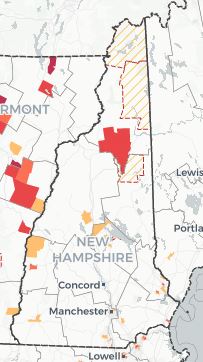
One of the most interesting resources available is the Hard to Count map. Areas in orange and red indicate known HTC areas in NH:
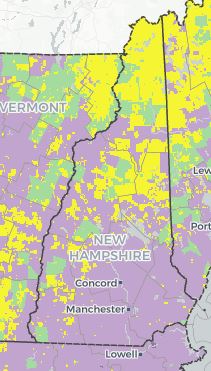
And this same map provides an overview of how people are going to be contacted. You can really zoom in on this map and see how you might be contacted. I’m kind of excited to see that I might just be in an area where we receive a hand-delivered packet! (Yes, I am a genealogy-junkie.)
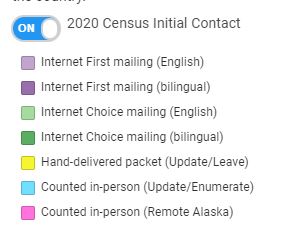
Here is the key:
Today I Learned:
The Census workers will do a headcount of homeless individuals at known encampments. However, individuals currently experiencing homelessness will be able to enumerate themselves online (or by phone, I believe) by selecting a location or even an intersection showing where they live. Unless they enumerate themselves, their names will not be taken by Census taker.
Please read through the FAQs provided by the ALA’s Libraries Guide to the 2020 Census on page 11-12:
When does the 2020 Census start?
The enumeration starts in remote Alaska on January 21, 2020, but most households will receive their census materials by U.S. mail or hand-delivery starting in mid-March. The online and telephone response options will be available starting on March 12, 2020.
How long does it take to fill out the form?
The Census Bureau estimates that it will take about 10 minutes to complete the census questionnaire, depending on the number of people in the household.
Do people have to respond online?
No, households have the option to respond to the census questionnaire in one of three ways: online, by telephone, or using a paper questionnaire.
In what languages will the online form be available?
The online form will be available in English and 12 non-English languages: Arabic, Chinese [Simplified], French, Haitian Creole, Japanese, Korean, Polish, Portuguese, Russian, Spanish, Tagalog, and Vietnamese. In what languages will the paper form be available? The paper form will be available in English and bilingual English-Spanish. Spanish-only forms will be available in Puerto Rico.
In what languages will telephone assistance be available?
Census Questionnaire Assistance will be available in English and the same 12 non-English languages referenced above, with Mandarin and Cantonese. People will also be able to use their Telecommunications Device for the Deaf (TDD) when calling.
What if I need some other language?
The Census Bureau will provide language guides in 59 non-English languages.
Can people respond on a smartphone or tablet?
Yes, the online form will be optimized to allow people to respond on a smartphone or tablet.
Can people respond if they have misplaced or never received the unique ID mailed or hand-delivered to their address?
Yes, people can respond online or by telephone using an option called Non-ID Response, which allows them to complete their census forms without the unique ID, as long as they provide a valid home address.
Is the online system secure?
Yes, the Census Bureau has taken significant steps to protect online responses. All information entered online is encrypted as soon as the respondent hits “submit.”
Will there be a problem if multiple people respond online from the same location or IP address?
The Census Bureau will only restrict IP addresses as a security precaution. For example, they may block an IP address if its activity appears to pose a security threat. They are anticipating and planning for multiple responses from computers in places like libraries, or generated through other outreach activities, such as block parties.
Can census responses be shared with law enforcement or other government agencies?
No, Title 13 of the U.S. Code protects the confidentiality of personally identifiable information provided in census responses, including citizenship status. Federal law prohibits the Census Bureau from sharing personally identifiable information with other government agencies. Census staff take a lifetime oath to protect census responses, with severe penalties for violations. The law prohibits personally identifiable information collected by the Census Bureau from being used against respondents by any government agency or court.
What should people do if they have a question or problem?
People can call Census Questionnaire Assistance toll-free for answers to questions or to provide their household responses by phone. The phone number will be available in early 2020. What happens if a person misses a question? The Census Bureau strongly encourages respondents to answer every question for every person in the household, but will allow submission of incomplete questionnaires. Bureau staff may follow up on incomplete submissions.
How do I identify an official census worker in person or over the phone?
Census workers must present an ID badge that includes their photo, the U.S. Department of Commerce watermark, and an expiration date. For more information, see these additional tips from the Census Bureau for identifying census workers. To verify, people can also contact Census Questionnaire Assistance, enter the name into the Census Bureau Staff Search, or contact the Regional Office50 for their state.
How can my library get 2020 Census materials (e.g. posters, pens, bookmarks)?
Census Bureau Partnership Specialists can provide 2020 Census materials. Staff can be reached at census.partners@census.gov. The Bureau also offers downloadable materials at www.census.gov/partners/2020-materials.html.
How can I invite the Census Bureau to give a presentation at my library?
Contact your Census Bureau Regional Office (see next page).
Check out the resources compiled on the Youth Services site maintained by Deborah Dutcher, too: